Best Beginner Guitars: 15 Proven Picks for Adults and Kids, by Budget
You don't need an expensive guitar to learn — but you do need one that stays in tune and is comfortable to play. These are long-running models with a strong track record, sorted by type and budget, plus straight answers to the questions every new player asks.
Prices are approximate US street prices and vary by country, retailer and time of year. Use them as budget bands, and always check the current price before you buy. We are independent and do not earn commission from any brand or store.
Quick picks: the best guitar for most beginners
| If you… | Get this type | Proven picks | Typical budget |
|---|---|---|---|
| Want to strum and sing pop, folk or rock | Steel-string acoustic | Yamaha FG800 / FS800, Fender CD-60S | $150–$300 |
| Are an adult on a tight budget | Steel-string acoustic | Yamaha F310 / F335-series | $120–$180 |
| Want the gentlest strings on your fingers, or play classical | Classical (nylon) | Yamaha C40, Cordoba C5 | $120–$350 |
| Love rock, blues, metal or funk | Electric + small amp | Yamaha Pacifica 112V, Squier Classic Vibe Strat | $300–$500 incl. amp |
| Want the easiest guitar to play | Electric (light strings, low action) | Squier Sonic Stratocaster, Yamaha Pacifica 012 | $200–$350 incl. amp |
| Have small hands or want a travel guitar | Small-body acoustic | Yamaha JR2, Taylor GS Mini | $150–$600 |
| Are buying for a child aged 6–12 | Classical in 1/2 or 3/4 size | Yamaha CGS series, Cordoba Protégé | $100–$200 |
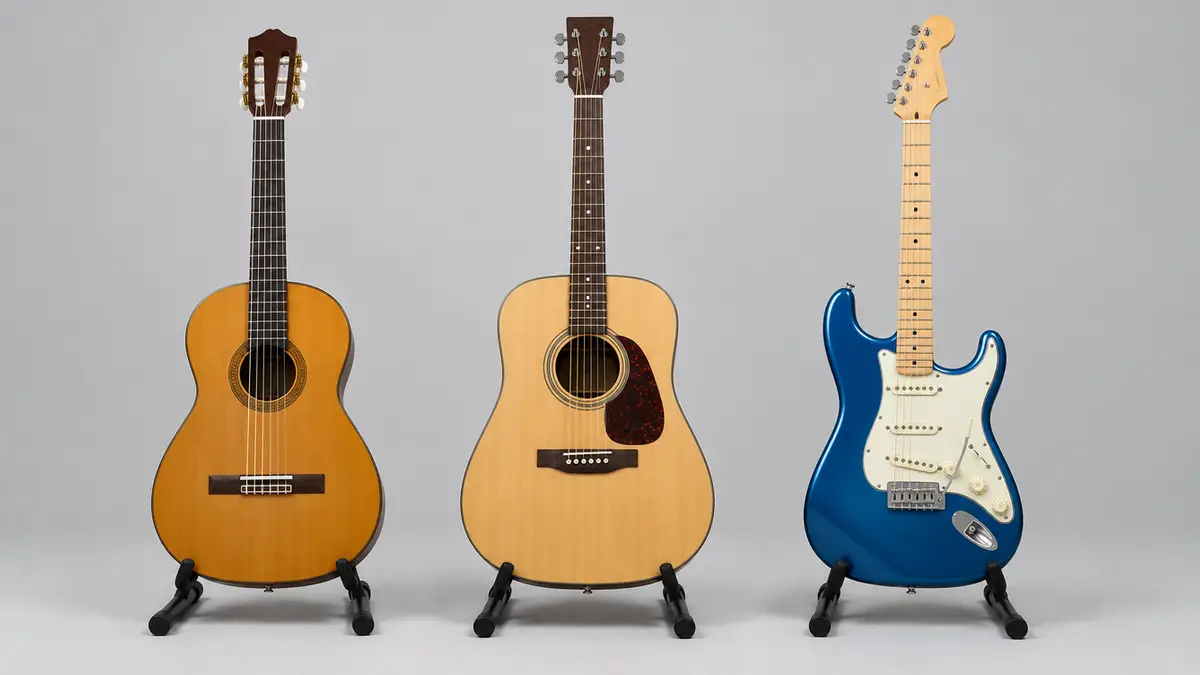
Not sure which type suits you? Read acoustic vs classical vs electric first — it takes five minutes and saves a lot of second-guessing.
What makes a good beginner guitar
- Playability first: low, even action (string height) and smooth fret ends. A guitar that is hard to press makes beginners quit.
- Tuning stability: decent tuners and a well-cut nut so the guitar stays in tune between sessions.
- Comfort: body size and neck shape that suit your frame. Smaller bodies are easier for smaller players and kids.
- Sound: nice to have — a solid top helps on acoustics — but playability matters more for learning.
A professional setup — adjusting the neck, action and intonation — can make an inexpensive guitar play like one costing twice as much. Many shops include it free when you buy. See guitar setup explained.
The 15 best beginner guitars
Acoustic (steel-string)
| Model | Why it's a good first guitar | Watch out for |
|---|---|---|
| Yamaha FG800 | Solid spruce top for a fuller sound, dreadnought volume, famously consistent quality at its price | Dreadnought body is large for smaller players |
| Yamaha FS800 | Same solid-top value as the FG800 in a smaller concert body — more comfortable to hold | A little less bass |
| Fender CD-60S | Solid mahogany top, warm sound, comfortable neck; often sold in bundles | Check action — some need a setup |
| Yamaha F310 / F335-series | Laminate top budget workhorse; reliable and durable | Simpler sound than solid-top models |
| Taylor GS Mini | Short scale and compact body, very easy to play, big sound for its size | Costs noticeably more |
| Yamaha JR2 | 3/4-size travel guitar — great for kids, small adults and travel | Small, quieter sound |
Classical (nylon-string)
| Model | Why it's a good first guitar | Watch out for |
|---|---|---|
| Yamaha C40 | The classic budget nylon guitar: soft strings, durable, easy on fingertips | Wide flat neck feels different from steel-string guitars |
| Cordoba C5 | Solid cedar top — warm, rich tone that rewards fingerstyle | Higher price than the C40 |
| Yamaha CGS series (1/2, 3/4) | Proper sizes for young children | Kids outgrow them — check the size guide |
Electric
| Model | Why it's a good first guitar | Watch out for |
|---|---|---|
| Yamaha Pacifica 112V | HSS pickups (one humbucker, two single-coils) cover almost every style; excellent quality control | Plain looks for some tastes |
| Squier Classic Vibe Stratocaster | Vintage-style Strat that many players keep for years; great neck and pickups | Near the top of the beginner budget |
| Squier Sonic Stratocaster / Telecaster | Lowest-cost proven option; light and comfortable | Basic hardware — a setup helps a lot |
| Yamaha Pacifica 012 | Budget sibling of the 112V; good starter-pack guitar | Simpler pickups and finish |
| Epiphone Les Paul / SG models | Two humbuckers for thick classic rock tones | Les Pauls are heavy — try before you buy |
| Ibanez GIO / GRX series | Thin, fast necks loved by rock and metal beginners | Check fret ends on the cheapest models |
Want more electric options? See the best electric guitars under $500.
Best guitars for adult beginners
Adults usually have full-size hands and arms, so a full-size guitar is right for most. The most important choices for adults are:
- Body size for comfort: if a dreadnought (FG800, CD-60S) feels bulky when you sit, choose a concert or auditorium body (FS800, GS Mini).
- Budget for quality: adults who buy a $80 guitar often struggle with high action. Spending $150–$300 on an acoustic or $300–$500 on an electric plus amp is the safest choice.
- Music you love: the guitar that matches your favourite music is the one you will practise most.
- Time and noise: busy adults in flats often practise more on an electric with a headphone amp — silent practice at any hour.
Best guitars for kids
Children under about 12 usually need a smaller guitar: 1/2 size for ages 6–8, 3/4 for 8–12. Nylon-string classical guitars are gentlest on small fingers. Use our guitar size guide by age and height.
What is the easiest guitar to learn on?
Physically, an electric guitar is usually the easiest: light strings, low action and a slim neck mean less pressure is needed. A classical guitar has soft nylon strings that are kindest to fingertips, but its wide neck can make chord shapes a stretch. A steel-string acoustic is the hardest on fingers for the first few weeks — but it is also the most popular choice and the pain is temporary.
- Ask for a setup with lower action
- Use lighter strings (extra light 10–47 on acoustic, 9–42 on electric) — see string gauges
- Choose a smaller body or shorter scale length if you have small hands
Budget guide
| Budget | Acoustic | Classical | Electric (guitar only) |
|---|---|---|---|
| Under $150 | Laminate top; check playability carefully | Good options exist (Yamaha C40) | Rare; usually starter packs |
| $150–$300 | The sweet spot — often a solid top | Solid-top models appear | Good budget models (Squier Sonic, Pacifica 012) |
| $300–$500 | Better electronics, finishes and small-body premium options | Solid tops with nicer back and sides | Excellent — many players never upgrade (Pacifica 112V, Classic Vibe) |
| $500+ | Solid wood throughout, premium brands | Concert-grade | Intermediate and pro models |
For an electric, add roughly $60–$200 for a practice amp or headphone amp, plus a cable and strap — see amps and headphone amps.
Cheap vs good beginner guitar: is a $100 guitar OK?
A very cheap guitar can work — if it has a decent setup. The problem is that cheap guitars are inconsistent: one may play fine, the next may have strings so high that chords are almost impossible. If your budget is under $150, buy from a shop that will set it up, or a recognised brand with good quality control, and use our checklist. Avoid unbranded "toy" guitars.
Solid top vs laminate
A solid top is made from a single piece of wood (usually split in two and book-matched). It vibrates more freely and generally sounds richer. A laminate top is layers of wood pressed together — less resonant, but tougher and more resistant to humidity changes. For a first acoustic, a solid top is a nice bonus but not essential. More in tonewoods explained.
New vs used
Used guitars from reputable brands hold their value and can save you 30–50%. The risk is hidden problems — use our inspection checklist. Buying new from a shop with a good return policy and a free setup is the safest option for complete beginners.
What else you need
- A tuner — or our free online tuner
- A few medium picks, a gig bag and a strap
- A spare set of strings
- Full list: essential guitar accessories
What to avoid
- Unbranded "toy" guitars and very cheap listings with no reviews.
- Guitars with visibly high strings over the 12th fret.
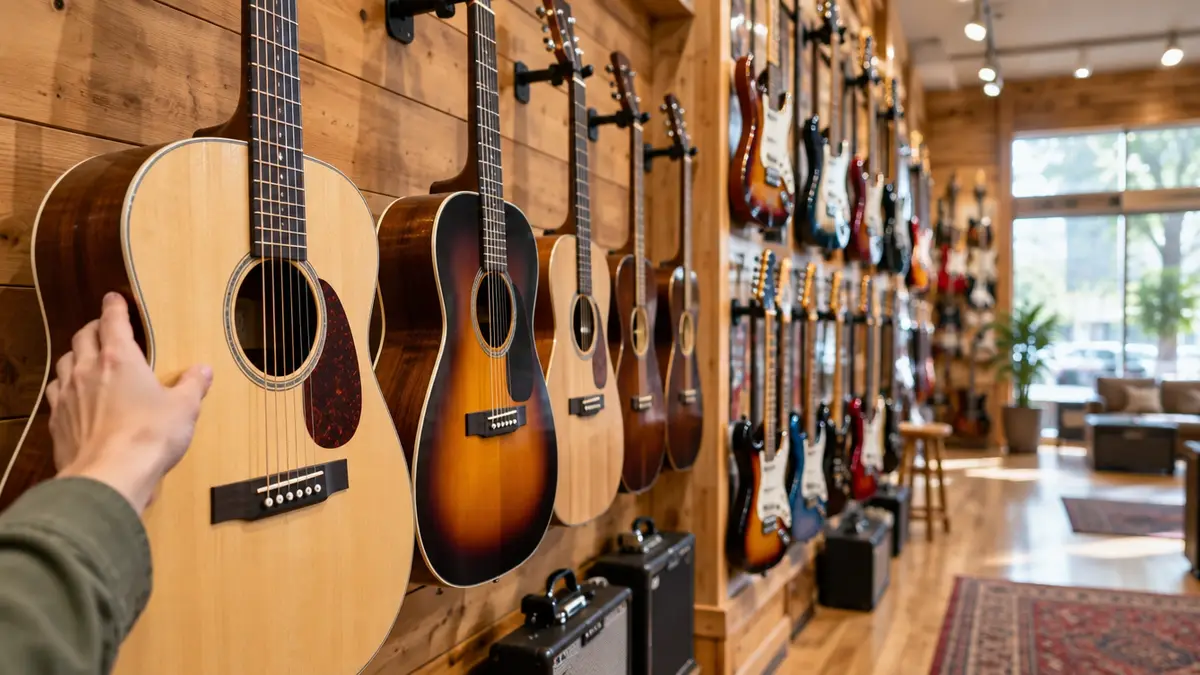
- Buying only on looks — try to hold and play it first, or buy with free returns.
- Spending your whole budget on the guitar and nothing on a tuner, strings and a setup.
Ready to start? Once your guitar arrives, follow our free 30-Day Guitar Plan.
Frequently asked questions
What guitar should a beginner buy?
For most beginners, a steel-string acoustic such as the Yamaha FG800 or FS800 is the safest first guitar. If you mainly love rock, blues or metal, choose an electric such as the Yamaha Pacifica 112V or a Squier Stratocaster with a small amp.
What is the best guitar for adult beginners?
A full-size acoustic in the $150–$300 range (Yamaha FG800/FS800, Fender CD-60S) or an electric such as the Yamaha Pacifica 112V. Choose a smaller concert body if a dreadnought feels bulky.
What is the easiest guitar to learn on?
Electric guitars are physically easiest because of their light strings and low action. Classical guitars are gentlest on fingertips. Steel-string acoustics are hardest at first, but finger soreness passes in a few weeks.
What is a good price for a beginner guitar?
Around $150–$300 for an acoustic, $120–$350 for a classical, and $300–$500 for an electric including a small amp. Below about $100, quality problems are common.
Is it better to start on acoustic or electric?
Start on the type that matches the music you want to play — motivation matters most. Skills transfer easily between them.
Which guitar brand is best for beginners?
Yamaha, Fender/Squier, Epiphone, Ibanez and Cordoba all make reliable beginner guitars. Yamaha is especially known for consistent quality at low prices. See our guitar brands comparison.
Is Yamaha good for beginners?
Yes. Yamaha is one of the most widely recommended brands for beginner acoustic, classical and electric guitars thanks to consistent quality control.
Should I buy a guitar online?
It is fine if the retailer has a good return policy and you check the guitar on arrival. Consider a professional setup afterwards.