Guitar Amps, Pedals and Headphones: A Beginner's Guide
Your amp is half of your electric guitar sound. Here is how to choose one for home practice — and how to play silently at night.
Prices are approximate US street prices and vary by country, retailer and time of year. Use them as budget bands, and always check the current price before you buy. We are independent and do not earn commission from any brand or store.
Types of amplifier
| Type | Pros | Cons |
|---|---|---|
| Solid-state | Cheap, reliable, light | Basic models can sound harsh when distorted |
| Modelling (digital) | Many amp sounds and effects built in, headphone out, often an app and Bluetooth | Menus can distract beginners |
| Valve (tube) | Classic warm tone and response | Heavier, more expensive, need to be loud to sound their best, valves wear out |
| Headphone amp | Plugs straight into the guitar; silent practice; tiny | No speaker for playing with others |
How many watts do I need?
- Home practice: 10–30 watts solid-state or modelling is plenty. Many players use far less than they think.
- Jamming with a drummer: 50–100 watts solid-state, or 15–30 watts valve.
- Gigging: depends on the venue; many use a PA system.
Look for a headphone output, an aux input for playing along with music, and ideally a built-in tuner.
Practice amps with a strong track record
- Boss Katana series — very popular modelling amps from mini to gig sizes.
- Fender Mustang LT / GTX and Champion series — modelling with Fender presets.
- Yamaha THR series — compact desktop amps that sound good at low volume and double as speakers.
- Positive Grid Spark — app-based smart amp popular with beginners.
- Blackstar ID:Core — affordable modelling amps.
Silent practice: headphone options
- Plug-in headphone amps (e.g. Fender Mustang Micro, Vox amPlug) — plug into the guitar, connect headphones, done.
- Amp headphone output — most modern practice amps have one.
- Audio interface + computer — use amp simulation software; great for recording too.
- Multi-effects units with headphone outputs.
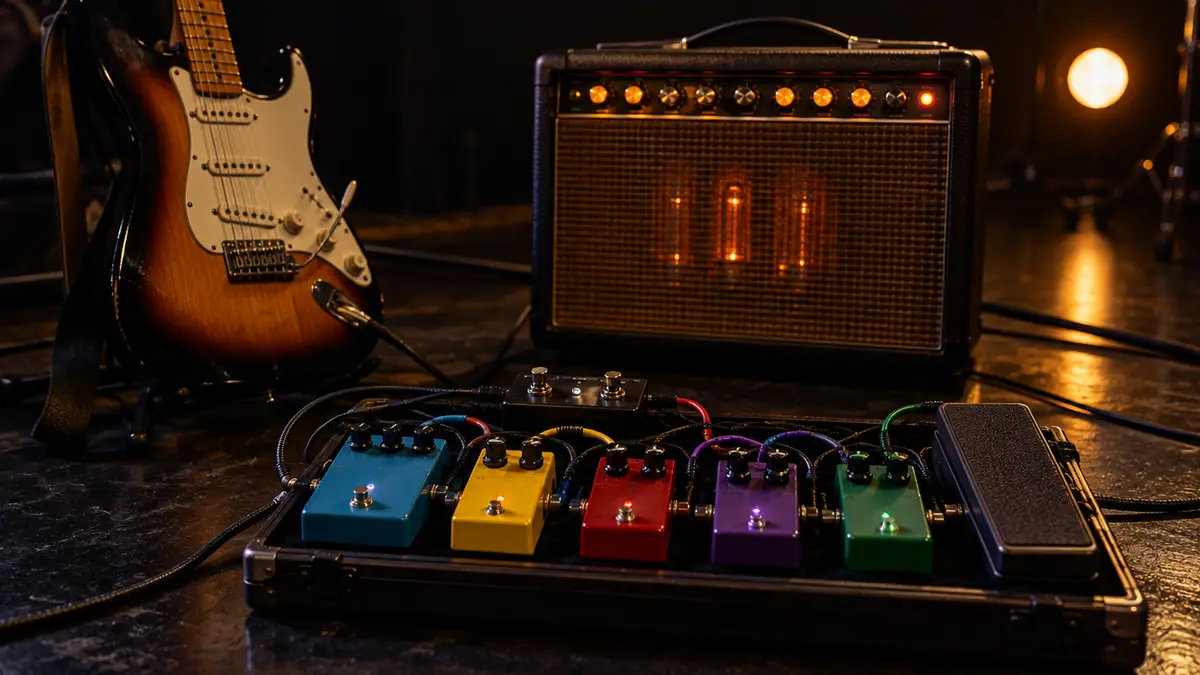
Effects pedals explained
| Pedal | What it does | Heard in |
|---|---|---|
| Tuner | Silent tuning on stage | Every pedalboard |
| Overdrive | Mild, amp-like crunch | Blues, classic rock |
| Distortion | Heavier, more compressed | Rock, punk |
| Fuzz | Buzzy, saturated vintage tone | 60s rock, stoner rock |
| Compressor | Evens out volume, adds sustain | Country, funk |
| Chorus | Shimmering, doubled sound | 80s pop, clean ballads |
| Delay | Echo repeats | Everywhere |
| Reverb | Sense of space/room | Everywhere |
| Wah | Vocal-like sweep with your foot | Funk, classic rock |
Pedal order
A common and reliable signal chain:
Guitar → Tuner → Wah/filter → Compressor → Overdrive/Distortion/Fuzz → Modulation (chorus, phaser, flanger) → Delay → Reverb → Amp
There are no strict rules — experiment — but this order gives predictable results.
Multi-effects vs individual pedals
For beginners, a multi-effects unit or modelling amp is the better value: dozens of effects, amp models and often a headphone output and USB recording for less than the price of three pedals. Individual pedals are more hands-on and fun to collect later.
Recording at home
- Get an audio interface with an instrument input (Hi-Z).
- Plug your guitar in and use a free DAW (recording software) with amp simulation plugins.
- Monitor on headphones to avoid feedback.
- Record yourself regularly — it is one of the best practice tools there is.
Frequently asked questions
Can I play electric guitar without an amp?
You can, but it will be very quiet and you won't hear your real tone. A headphone amp is an inexpensive way to practise silently.
What amp should a beginner buy?
A 10–30 watt modelling practice amp with a headphone output is ideal — it gives many sounds, works quietly and grows with you.
Do I need pedals as a beginner?
No. Learn on a clean and a slightly overdriven amp sound first. Add pedals once you know what sound you are chasing.