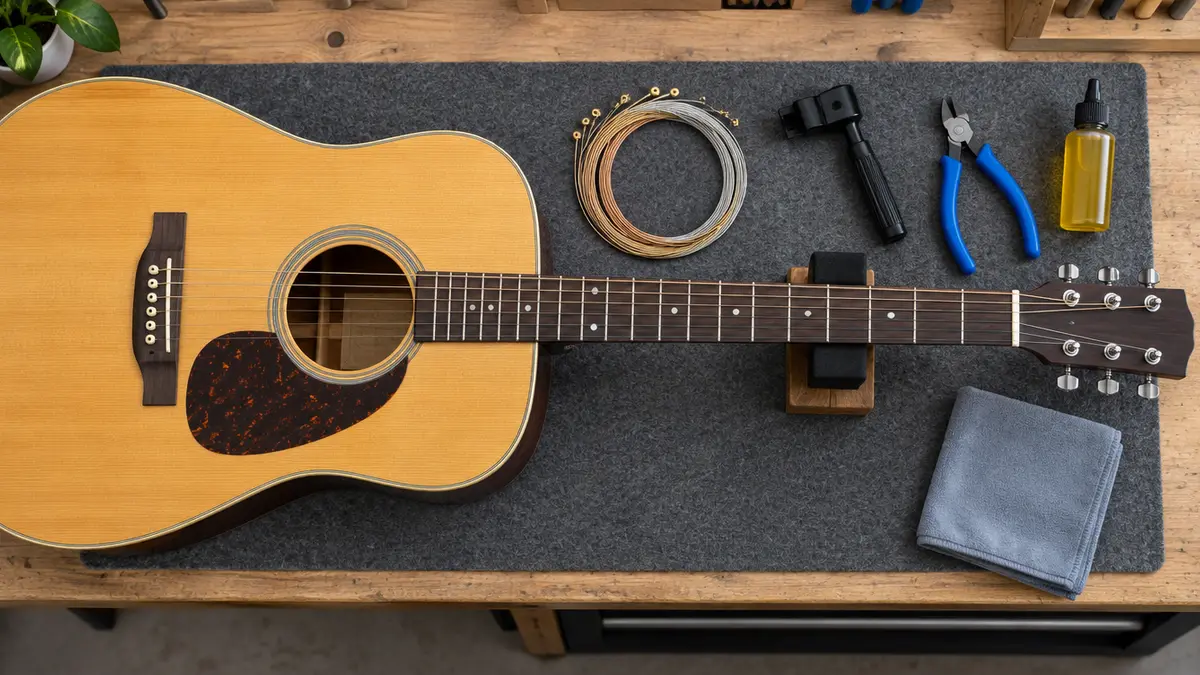
Guitar Setup Explained: Action, Truss Rod, Intonation and Scale Length
A good setup makes a guitar easier to play and more in tune. Here is what each adjustment does, how to check it, and how to make small changes safely.

- Tune to pitch with the strings you plan to use
- Neck relief (truss rod)
- Action (string height at the bridge)
- Intonation
- Pickup height (electric)
Each step affects the next. Retune after every adjustment.
1. Neck relief and the truss rod
The truss rod is a metal rod inside the neck that counteracts string tension. A neck should have a very slight forward curve called relief.
How to check relief
- Tune to pitch.
- Place a capo on the 1st fret (or hold the string down there).
- Hold the 6th string down at the fret where the neck joins the body (around the 14th–17th).
- Look at the gap between the bottom of the string and the top of the 7th–8th fret. Around 0.2–0.3 mm (the thickness of a business card) is typical.
- No gap / string touching: the neck is back-bowed — loosen the truss rod slightly (counter-clockwise).
- Large gap: too much relief — tighten the truss rod slightly (clockwise).
Turn a maximum of a quarter turn at a time, then wait (the neck takes time to settle) and re-check. If the nut is very hard to turn, stop — forcing it can break the rod. When in doubt, take it to a technician.
2. Action (string height)
Action is measured at the 12th fret, from the top of the fret to the bottom of the string.
| Guitar | Low E (6th) | High E (1st) |
|---|---|---|
| Electric | 1.6–2.0 mm | 1.4–1.6 mm |
| Acoustic | 2.2–2.8 mm | 1.6–2.0 mm |
| Classical | 3.5–4.0 mm | 2.5–3.0 mm |
- Electric: raise or lower each bridge saddle with a small hex key or screwdriver.
- Acoustic: action is adjusted by sanding the bottom of the saddle (to lower) or shimming it (to raise). This is a careful job — small amounts matter. Many players leave it to a technician.
- Lower action = easier to play but more risk of buzzing. Find the lowest setting that doesn't buzz with your playing style.
3. Intonation and scale length
Scale length is the distance from the nut to the saddle — for example 25.5" on Stratocaster-style guitars and 24.75" on Les Paul-style guitars. Frets are placed mathematically for that length. But pressing a string down stretches it slightly, so the saddle must be adjusted to compensate. That adjustment is intonation.
How to set intonation on an electric guitar
- Tune the open string perfectly.
- Play the 12th-fret harmonic, then the fretted 12th-fret note, and compare on a tuner.
- Fretted note sharp: move the saddle back (away from the neck), lengthening the string.
- Fretted note flat: move the saddle forward (towards the neck).
- Retune and repeat until both match. Do each string.
On most acoustics the saddle is fixed, so intonation problems require a technician.
4. Pickup height (electric)
Pickups that are too close to the strings can cause odd overtones and reduce sustain; too far and the sound is weak. As a starting point, hold down the last fret and measure about 2–3 mm from the pickup pole to the string on the bass side and slightly less on the treble side. Adjust by ear so all pickups are balanced in volume.
When to see a professional
- Buzzing that setup adjustments won't fix (uneven frets).
- Nut slots that are too high (hard to play near the nut) or too low (open strings buzz).
- A truss rod that is at its limit or won't turn.
- Acoustic neck reset needed (very high action with the saddle already low).
A professional setup usually costs about as much as a few sets of strings — and is the best-value upgrade you can buy for your guitar.
Frequently asked questions
How often does a guitar need a setup?
Once or twice a year for most players, usually when the seasons change and humidity shifts, or whenever you change string gauge.
Can adjusting the truss rod damage my guitar?
Small adjustments done carefully are safe. Overtightening or forcing a stuck rod can cause damage — stop and see a technician if it feels stiff.