Acoustic, Classical or Electric? How to Choose Your First Guitar
The "best" first guitar is the one you will actually want to pick up every day. Here is how the three main types compare — and how to decide in five minutes.
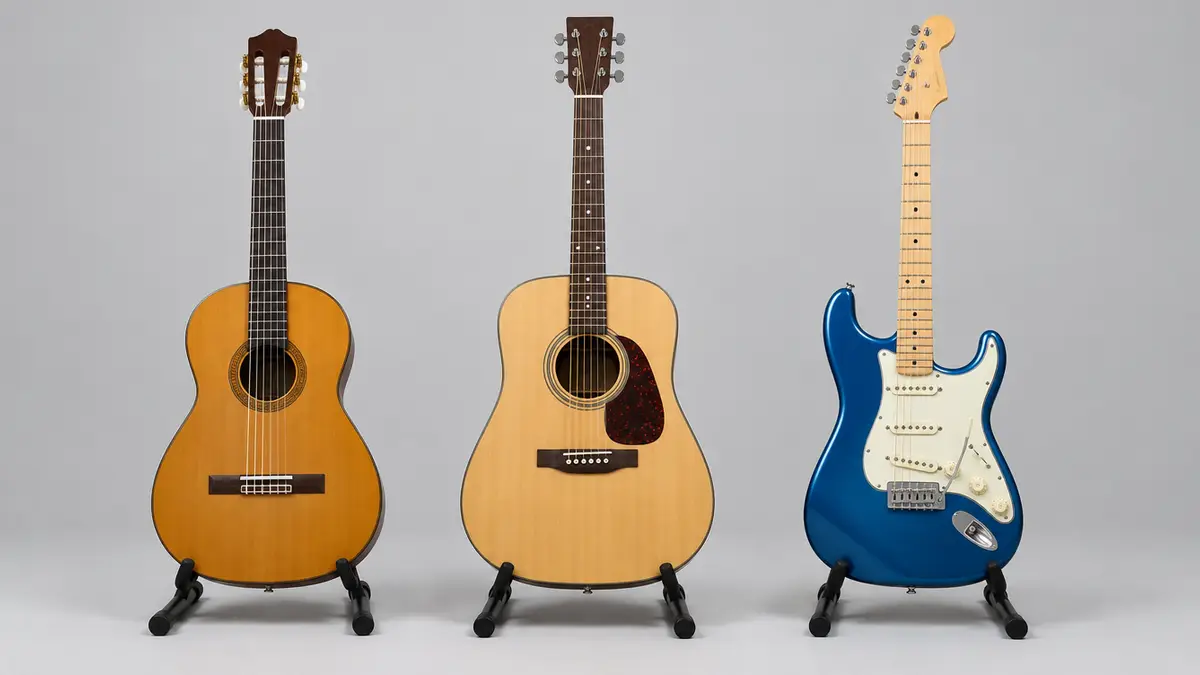
The quick answer
- You want to sing along, play around the campfire or strum pop and folk songs: a steel-string acoustic.
- You want to play rock, blues, metal or funk — or you are sensitive to finger pain: an electric guitar with a small amp or headphones.
- You want classical, flamenco, bossa nova, or a guitar for a young child: a nylon-string classical guitar.
Any of the three will teach you the same chords, scales and rhythm. Skills transfer easily between them, so do not worry about "choosing wrong" — choose the sound that excites you.
The three types compared
| Classical (nylon) | Acoustic (steel) | Electric | |
|---|---|---|---|
| Sound | Warm, soft, mellow | Bright, loud, full | Depends on amp: clean to heavily distorted |
| Feel on fingers | Easiest — soft strings | Hardest at first | Easy — light strings, low action |
| Neck | Wide and flat | Medium | Slim, fast |
| Extra gear needed | None | None | Amp or headphone amp, cable |
| Typical starter cost | $100–$250 | $150–$300 | $200–$400 with amp |
| Best for | Classical, Latin, kids | Pop, folk, singer-songwriter | Rock, blues, metal, funk |
Nylon vs steel strings
This is the biggest difference between classical and acoustic guitars. Nylon strings are thick, soft and under lower tension, so they are gentle on your fingertips. Steel strings are thinner and under much higher tension, which gives a brighter, louder sound but hurts more for the first few weeks.
Classical guitars are not built for the tension of steel strings. Fitting them can bend the neck or pull the bridge off. The reverse (nylon on a steel-string acoustic) also does not work properly because the bridge and nut are designed differently.
Finger pain on steel strings is temporary. After two to four weeks of daily practice, calluses form and the pain disappears. If pain is the only thing stopping you from choosing an acoustic, it is not a good reason to give up on the sound you want. See our guide to common beginner problems.
Why electric guitars are often easier
People are surprised by this, but an electric guitar is usually the easiest to play: the strings are lighter, sit closer to the fretboard and the neck is thinner. The trade-offs are the need for an amplifier and a little more upfront cost. A small practice amp or a headphone amp lets you play silently at night — useful if you share walls.
If you go electric, read our guide to amps, pedals and headphones before buying.
What size guitar do you need?
Most teenagers and adults use a full-size guitar. Children under about 12, and some smaller adults, are more comfortable on a 1/2, 3/4 or 7/8 size. We have a full guitar size guide by age and height.
Body shapes for acoustic guitars
- Dreadnought: the classic large body. Loud and bass-heavy, great for strumming.
- Concert / Grand Auditorium: a narrower waist, more comfortable to hold and balanced for both strumming and fingerpicking. A great choice for smaller players.
- Parlor / travel: small body, easy to carry, quieter and less bass.
- Cutaway: a scoop near the neck to reach the high frets. Handy but not essential for beginners.
What to avoid
- Very cheap "toy" guitars (often under $80) with high action that makes chords almost impossible to press.
- Guitars that will not stay in tune — usually a sign of poor tuning machines or a bad nut.
- Buying online with no return policy — you cannot check playability until it arrives.
- Choosing a guitar only for its looks. Comfort and playability come first.
Ready to shop? See our beginner guitars by budget and the checklist for inspecting a guitar.
Frequently asked questions
Is acoustic or electric better for a beginner?
Neither is objectively better. Electric guitars are physically easier to play; acoustics need no extra gear. Choose the one that matches the music you want to play — that keeps you motivated.
Can I learn on a classical guitar and switch later?
Yes. Chords, rhythm and scales are the same. You will just need a few weeks to adjust to steel strings and a narrower neck.
Are electro-acoustic guitars worth it?
An electro-acoustic has a built-in pickup so you can plug into an amp or PA. It is only worth the extra cost if you plan to perform or record.