How to Hold a Guitar and Pick: Posture, Hand Position & Parts of the Guitar
Good posture from day one makes chords easier, stops pain and prevents bad habits that are hard to unlearn later. It takes five minutes to get right.

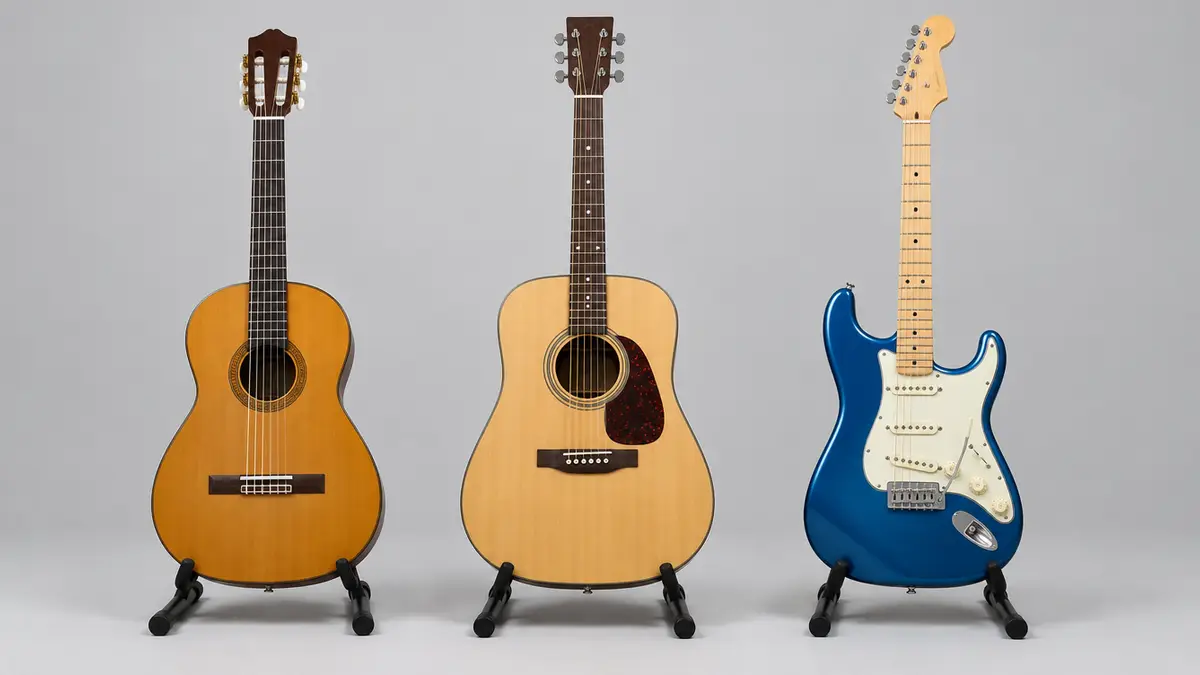
Parts of the guitar
| Part | What it does |
|---|---|
| Headstock | The top end of the guitar that holds the tuning pegs. |
| Tuning pegs (machine heads) | Turn them to tighten or loosen each string and change its pitch. |
| Nut | The small slotted bar between the headstock and fretboard that guides the strings. |
| Neck and fretboard | The long part you hold. The fretboard is the flat front surface you press strings against. |
| Frets | Metal strips across the fretboard. Each fret raises the pitch by one semitone. |
| Fret markers (inlays) | Dots that help you find frets 3, 5, 7, 9 and 12 quickly. |
| Body | The large part of the guitar. On acoustics it is hollow and amplifies the sound. |
| Sound hole | The round opening on an acoustic guitar body. |
| Bridge and saddle | Anchor the strings to the body and transfer vibrations. |
| Pickups (electric) | Magnets that turn string vibration into an electrical signal. |
| Strap buttons | Pins for attaching a strap. |
Strings are numbered from 1 (thinnest, highest pitch) to 6 (thickest, lowest pitch). In standard tuning they are, from thickest to thinnest: E A D G B E. A popular memory aid: Eddie Ate Dynamite, Good Bye Eddie.
Sitting position
- Sit on a chair without armrests, near the front edge, feet flat on the floor.
- Rest the waist of the guitar on your right thigh (if you are right-handed). The back of the guitar should touch your stomach and chest.
- Keep the neck angled slightly upward — the headstock roughly at shoulder height.
- Rest your right forearm on the top edge of the body so your hand falls naturally over the sound hole or pickups.
- Sit up straight. Resist the urge to lean over to look at the fretboard — tilt your head instead.
Classical guitarists rest the guitar on the left thigh, raised with a footstool or a support. This puts the neck higher and gives the fretting hand more freedom. It is worth trying if you play fingerstyle.
Standing with a strap
Adjust the strap so the guitar sits in roughly the same place as when you are sitting. Many beginners wear the guitar far too low because it looks cool — it makes chords much harder. Practise standing for part of your session if you plan to perform.
Fretting hand (left hand)
- Place your thumb behind the neck, roughly behind your middle finger. Keep it relaxed — no death grip.
- Press with the tips of your fingers, with fingers curved like you are holding a ball. This stops them touching neighbouring strings.
- Press just behind the fret (on the side closer to the body), not on top of it and not in the middle of the space.
- Use only as much pressure as you need for a clean note. Test this: press lightly, then gradually harder until the buzz stops.
- Keep your nails short on the fretting hand.
Fingers are numbered: 1 = index, 2 = middle, 3 = ring, 4 = little finger. Chord diagrams on this site use these numbers.
How to hold a pick
- Curl your index finger slightly.
- Lay the pick on the side of the index finger's last joint, pointed tip facing away from you.
- Press your thumb down flat on top of the pick.
- Let only 2–3 mm of the tip stick out. Too much and it flaps; too little and you will miss strings.
- Grip firmly enough that it does not fly away, but keep your wrist loose.
For strumming, move from the wrist and forearm in a relaxed motion — like shaking water off your hand — rather than from the elbow. Beginners usually do best with a medium pick, around 0.6–0.73 mm thick.
Common posture mistakes
- Guitar body tilted up so you can see the strings — it forces your wrist into an awkward angle.
- Thumb hooked high over the neck while playing open chords, pulling fingers flat.
- Shoulders raised and tense. Take a breath and drop them every few minutes.
- Squeezing the neck too hard. Tension is the number one cause of fatigue and pain.
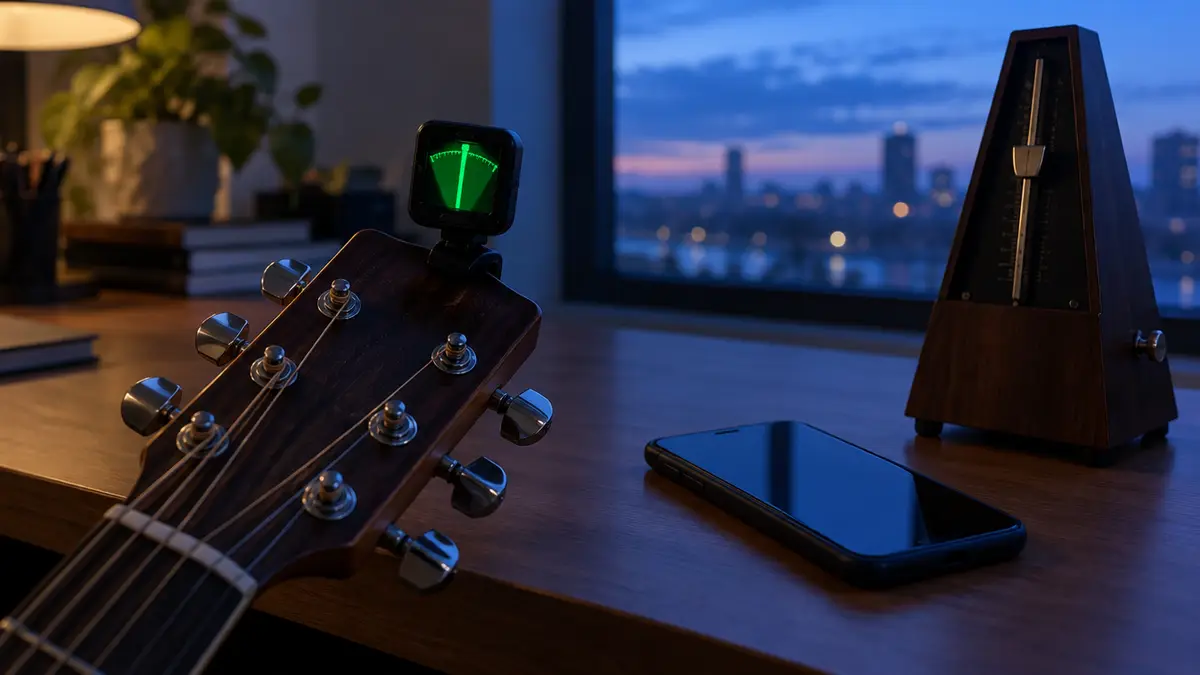
Next step: tune your guitar, then learn your first chords.
Frequently asked questions
Is it OK to play guitar left-handed?
Yes. Left-handed players can buy a left-handed guitar (mirrored) or learn right-handed. Many left-handed people play right-handed guitars successfully — try both before buying.
Should I look at my fretting hand?
At first, yes — glance down by tilting your head, not the guitar. Over time you will learn to find positions by feel.
What pick thickness should a beginner use?
A medium pick (roughly 0.6–0.73 mm) is a good all-rounder. Thin picks are easy for strumming; thick picks give more control for single notes.