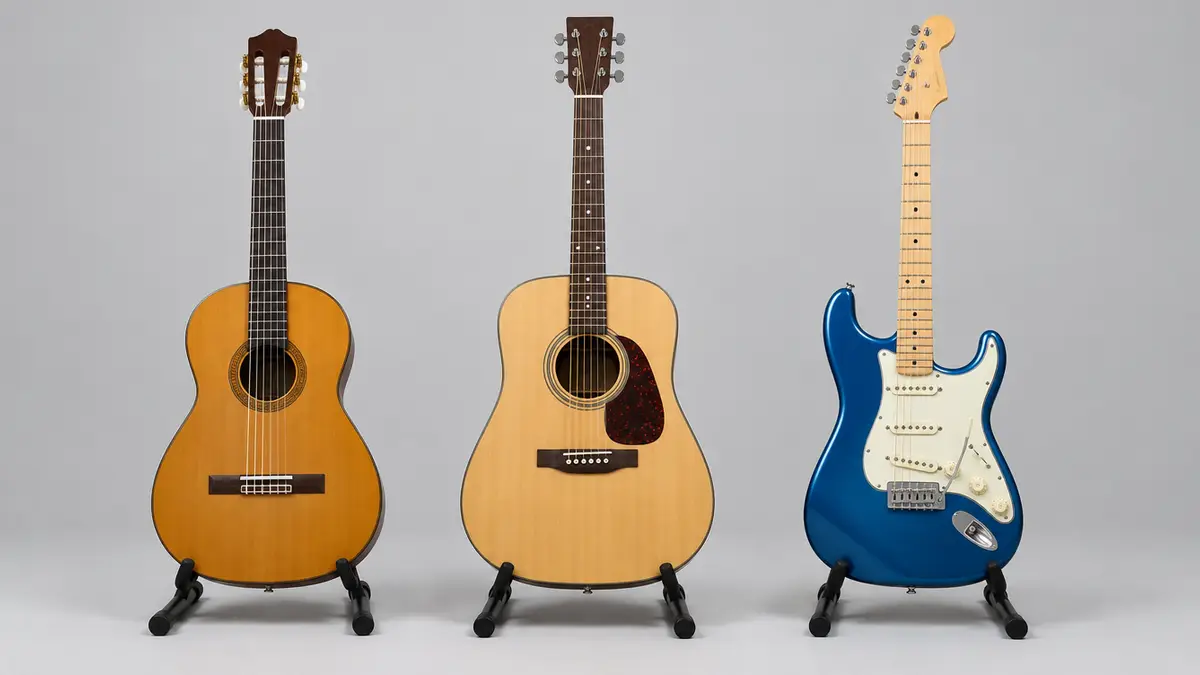
How to Tune a Guitar: With a Tuner, an App or by Ear
An out-of-tune guitar makes even perfect chords sound wrong. Tune every time you pick it up — it takes less than a minute once you know how.
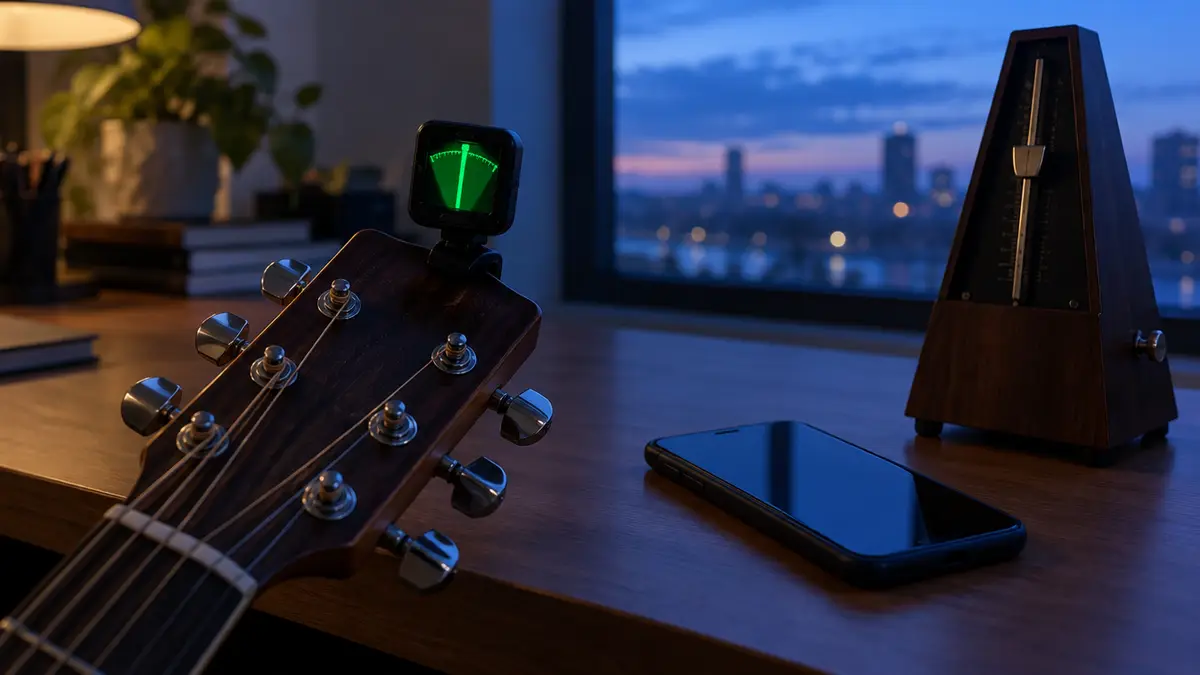
Standard tuning: E A D G B E
| String | Note | Pitch | Frequency |
|---|---|---|---|
| 6 (thickest) | E | E2 | 82.41 Hz |
| 5 | A | A2 | 110.00 Hz |
| 4 | D | D3 | 146.83 Hz |
| 3 | G | G3 | 196.00 Hz |
| 2 | B | B3 | 246.94 Hz |
| 1 (thinnest) | E | E4 | 329.63 Hz |
Use our free online guitar tuner. It listens through your microphone and shows whether each string is flat or sharp.
Which way do I turn the peg?
Turning a peg tightens or loosens the string. Tighter = higher pitch, looser = lower pitch. On most guitars, turning the peg counter-clockwise (when you look at the peg head-on from the end of the headstock) raises the pitch, but it depends on which side of the headstock the peg is on. The easy way: pluck the string, turn the peg slightly, and watch the tuner. If the note goes the wrong way, turn the other way.
If a string is sharp (too high), loosen it until it is below the target, then tighten up to the correct pitch. This keeps the string tight against the gears so it stays in tune longer.
Method 1: Clip-on tuner
- Clip the tuner onto the headstock and switch it on. Set it to "Guitar" or "Chromatic" mode.
- Pluck the 6th string (thickest) once and let it ring.
- Read the note. The display shows the note name and a needle or light: left = flat (too low), right = sharp (too high).
- Turn the peg slowly until the display shows E and the needle is centred (usually it turns green).
- Repeat for strings 5 to 1: A, D, G, B, E.
- Check all six strings a second time — tuning one string slightly changes the tension on the others.
Clip-on tuners sense vibration through the wood, so they work even in a noisy room. They are the most reliable option for beginners and cost very little.
Method 2: Phone app or online tuner
Apps and online tuners use your device's microphone. They work well in a quiet room. Hold the phone or laptop close to the guitar's sound hole (or the amp for an electric). Our browser tuner also plays reference tones for each string so you can tune by ear.
Method 3: Tuning by ear (the 5th-fret method)
This method tunes the guitar to itself. It's useful when you have no tuner — and it trains your ear. First, get the 6th string as close to E as you can (from a piano, a reference tone or another guitar).
- Press the 6th string at the 5th fret — that is an A. Tune the open 5th string to match it.
- Press the 5th string at the 5th fret (D). Tune the open 4th string to match.
- Press the 4th string at the 5th fret (G). Tune the open 3rd string to match.
- Press the 3rd string at the 4th fret (B) — note the exception! Tune the open 2nd string to match.
- Press the 2nd string at the 5th fret (E). Tune the open 1st string to match.
When two notes are almost but not quite the same, you will hear a "wobble" or beating. As you get closer, the wobble slows down and disappears when the notes match.
Why won't my guitar stay in tune?
- New strings stretch. Gently pull each new string away from the fretboard a few times and retune. Expect a day or two of frequent retuning.
- Temperature and humidity changes. Let a guitar adjust to the room for 15–30 minutes after bringing it in from the cold.
- Poor winding. Too few or too many wraps around the tuning post. See how to change strings.
- Worn tuners, a sticky nut or an unstable tremolo on electric guitars. See small repairs.
Alternate tunings
Once you are comfortable, you will meet other tunings: Drop D (lower the 6th string to D — popular in rock), Open G (D G D G B D — slide and blues), DADGAD (folk) and Half-step down (Eb Ab Db Gb Bb Eb — many classic rock bands). Stick to standard tuning while learning your first chords.
Frequently asked questions
How often should I tune my guitar?
Every time you play. Guitars drift out of tune with temperature, humidity and playing.
What does 440 Hz mean on a tuner?
It is the reference pitch for the note A4. Almost all modern music uses A = 440 Hz, so leave your tuner at this setting.
Why does my guitar sound out of tune even when the tuner says it is right?
The intonation may be off, meaning notes higher up the neck are sharp or flat. It can also be caused by pressing too hard. See our setup guide.