How to Change Guitar Strings: Acoustic, Electric and Classical
Fresh strings sound brighter, stay in tune better and are easier to play. Changing them takes 20–30 minutes the first time and 10 minutes once you have the hang of it.
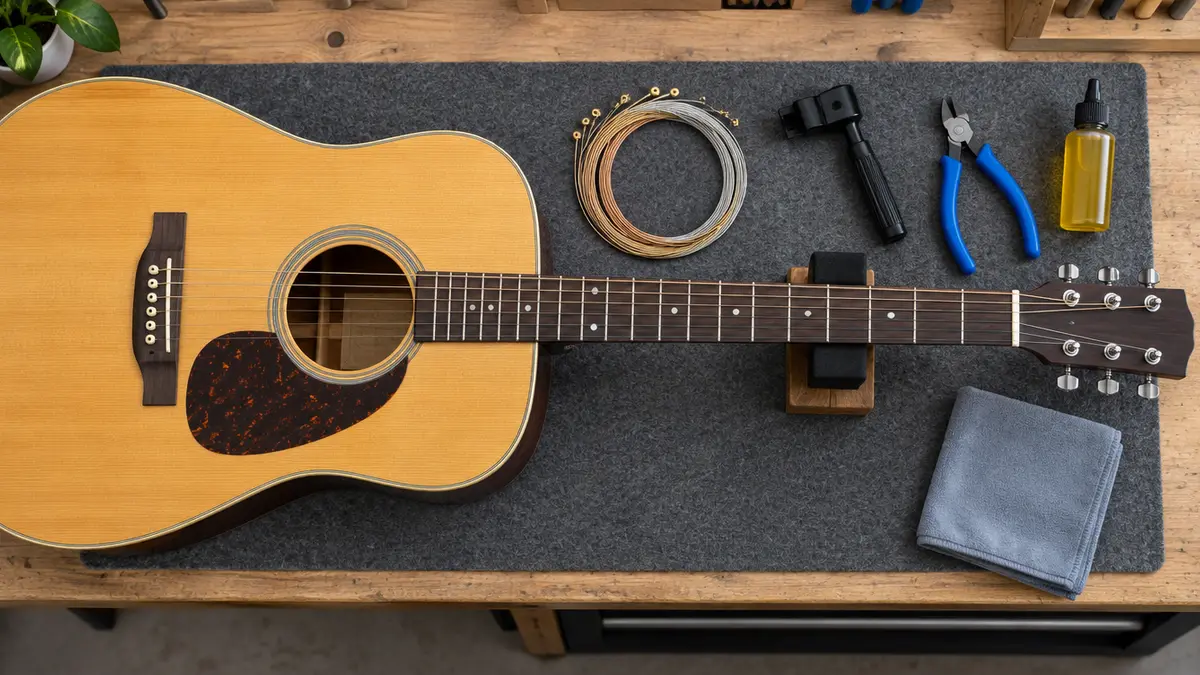
What you need
- A new set of strings of the right type (how to choose)
- String winder (optional but fast)
- Wire cutters
- A tuner
- A soft cloth; optionally fretboard conditioner for unfinished rosewood/ebony boards
Either works. Changing all at once lets you clean the fretboard. Changing one at a time keeps tension on the neck and is useful on guitars with floating tremolos. On most guitars it makes no difference to the neck to have the strings off for a short time.
Steel-string acoustic guitar
- Loosen each string until it is slack, then cut it in the middle or unwind it completely.
- Remove the bridge pins with the notch on your string winder, pushing gently from inside the sound hole if stuck. Keep them in order.
- Clean the fretboard and body while the strings are off.
- Insert the new string: put the ball end into the bridge hole, then push the pin in with its groove facing the string. Pull the string gently while pressing the pin so the ball end seats against the bridge plate, not the pin.
- Measure slack: pull the string to the tuning post, then add about 5–7 cm (2–3 inches) of slack — roughly the distance to the next post.
- Thread and bend: pass the string through the post hole, bend it sharply, and start winding so the string wraps downward on the post, towards the headstock.
- Wind: aim for 2–3 wraps on the thin strings and 1–2 on the thick strings. Keep tension with your other hand while winding.
- Tune up to pitch, then cut the excess leaving about 5 mm.
- Stretch: pull each string gently away from the fretboard along its length, retune, and repeat 2–3 times.
Electric guitar
- Remove the old strings. Most go through the body or a stop tailpiece; on a Strat-style tremolo they go through the back plate.
- Thread the new string through the bridge until the ball end seats.
- Pull the string to its post and add slack: about 5 cm for the wound strings and a little more for the plain strings.
- Thread through the post, crimp it sharply, and wind downward: 2–4 wraps for thin strings, 1–2 for thick.
- Tune up, stretch, retune and trim.
- If you changed string gauge, check the intonation. On floating tremolos, you may need to adjust the springs.
If your guitar has locking tuners, pull the string tight through the post, turn the locking wheel, and tune up. You need only about half a wrap — very fast and stable.
Classical (nylon-string) guitar
- Tie the string at the bridge: pass it through the hole from the sound-hole side, loop it back around itself and tuck it under 2–3 times (the treble strings need more loops). Pull tight so the knot sits on the back edge of the bridge.
- At the headstock, pass the string through the roller hole, loop it back under itself so it locks, and wind so the string comes off the top of the roller.
- Nylon strings stretch a lot. Expect to retune many times over the first day or two.
Common mistakes
- Too many wraps on the post — causes tuning instability.
- Too few wraps (under one) — the string can slip.
- Winding the string upward on the post, reducing the break angle over the nut.
- Putting strings in the wrong slots — check each string's gauge on the packet.
- Forgetting to stretch — the guitar will keep going flat.
- Cutting the string before it is tuned to pitch.
When to change strings
- They look dull or discoloured, or feel rough.
- The tone is dull with little sustain.
- The guitar won't stay in tune or chords sound out of tune up the neck.
- Typically every 1–3 months for regular players, or before a gig or recording.
Frequently asked questions
How long does it take to change guitar strings?
About 20–30 minutes for your first time, and 10–15 minutes once you are practised.
Why do new strings keep going out of tune?
New strings stretch. Stretch them gently by hand after installing and retune a few times; they settle within a day or two.
Can I reuse old strings?
It is not recommended. Once a string has been bent around a post and worn, it will not hold tune or sound as good as a new one.