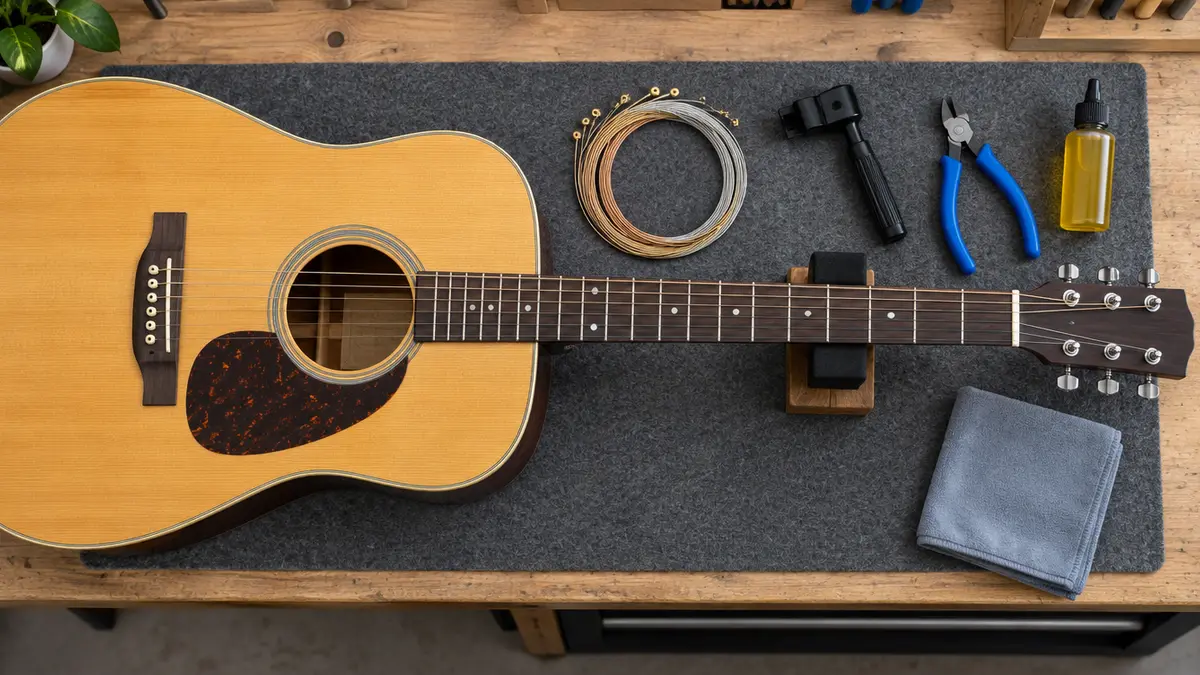
Small Guitar Repairs: Tuners, Nut, Crackling Pots, Hum and Buzz
Many annoying guitar problems have simple fixes. Here is how to diagnose and fix the most common ones — and when to leave it to a technician.

Loose or slipping tuners
- Wobbly tuner: tighten the hex nut on the front of the headstock (use the correct socket — do not overtighten) and the small screw on the back.
- Tuner button loose: many have a small screw on the end of the button — tighten it to adjust stiffness.
- Guitar won't stay in tune: check the string winding first (see changing strings). Worn tuners can be replaced with the same footprint model.
Nut problems
- "Pinging" sound while tuning, or strings sticking: the string is binding in the nut slot. Rub a soft pencil (graphite) into the slot or use nut lubricant.
- Open strings buzz: the nut slot may be too low. A technician can shim or replace the nut.
- Hard to play near the headstock / 1st-fret notes sharp: the nut slots are too high. Filing them is precise work — best done by a technician.
Crackling knobs and switches
Crackling when you turn a volume or tone knob is usually dust or oxidation inside the potentiometer ("pot").
- Turn the knob fully back and forth 20–30 times — this often cleans it.
- If it persists, spray a small amount of electronics contact cleaner into the pot opening (you usually need to remove the control plate or pickguard), then rotate again.
- Do the same for a crackling pickup selector switch.
- If the crackle continues, the pot may need replacing.
Loose output jack
A cutting-out signal when you move the cable usually means a loose jack. Hold the jack from the inside (or through the plate) so it does not twist, and tighten the outer nut. If the signal still cuts out, the jack's contact may need bending back or the solder joint may need re-doing.
Hum, buzz and noise in electric guitars
| Symptom | Likely cause | Fix |
|---|---|---|
| Hum that disappears when you touch the strings | Normal grounding behaviour; stronger with single-coils | Normal; if extreme, check the bridge ground wire |
| Hum that gets louder when you touch the strings | Grounding problem | Have the wiring checked |
| Loud hum only with single-coil pickups | 60-cycle hum from lights, monitors, dimmers | Turn guitar away from the source; use the in-between pickup positions; noise gate |
| Crackling and cutting out | Faulty cable | Try another cable first! |
| Constant hum from amp | Ground loop or noisy power supply | Plug all gear into the same outlet; try an isolated power supply for pedals |
Never open an amplifier — especially a valve amp — unless you are qualified. Amps contain capacitors that can hold lethal voltages even when unplugged.
Fret buzz
- Buzz on open strings: nut too low, or relief too small.
- Buzz on the first few frets: not enough neck relief — see truss rod.
- Buzz high up the neck: action too low, or a high fret / fret sprout.
- Buzz at one fret only: the next fret up may be high — needs fret levelling by a technician.
- Rattle, not buzz: check for loose tuner nuts, strap buttons, output jack, pickguard screws or something inside the body.
Strap button coming loose
If the screw spins without tightening, the hole is stripped. Remove the screw, insert a wooden toothpick with a little wood glue, snap it flush, let it dry and re-screw. For heavy guitars, strap locks are a wise upgrade.
Frequently asked questions
Why does my electric guitar hum?
Single-coil pickups pick up electromagnetic interference from lights, screens and power supplies. Some hum is normal; a sudden increase can mean a grounding fault or a bad cable.
Is fixing a guitar myself safe?
Simple tasks such as tightening hardware, cleaning pots and lubricating the nut are safe. Fretwork, nut cutting, structural repairs and amp repairs are best left to professionals.