Intermediate Guitar Lessons: Barre Chords, Pentatonic Scale and First Solos
Barre chords and the pentatonic scale are the two big skills that open up the whole fretboard. Here is how to learn both without frustration.
Barre chords, step by step
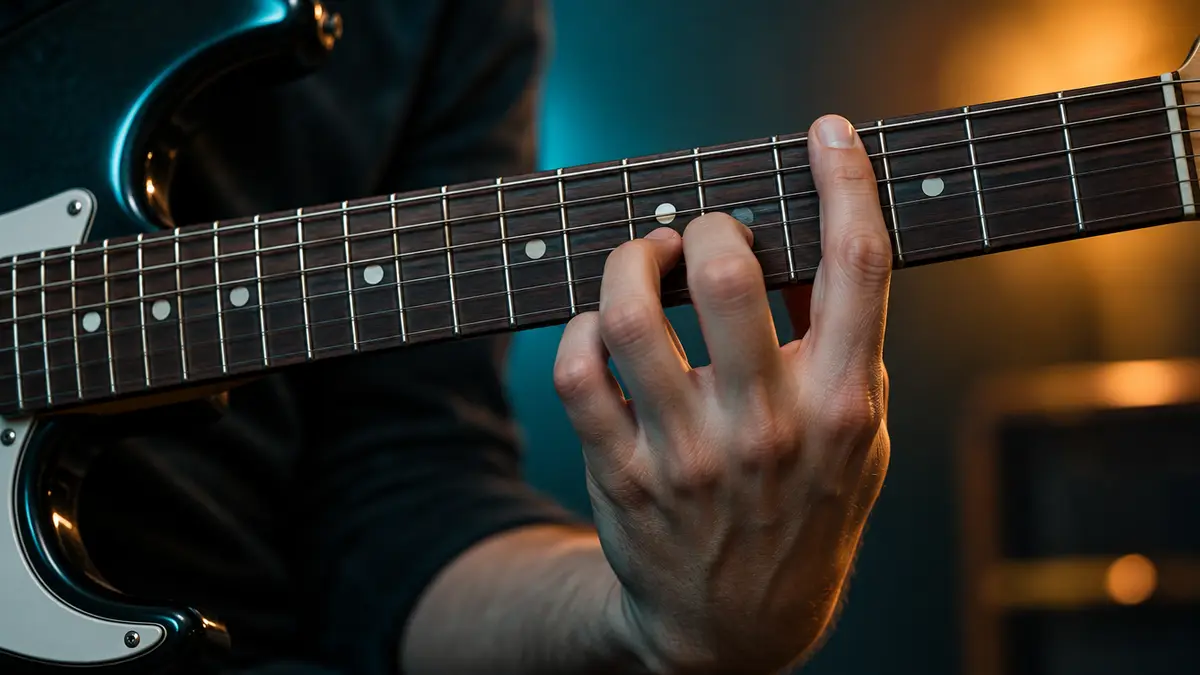
A barre chord uses your index finger as a movable "nut" pressed across several strings. Learn two shapes and you can play any major or minor chord anywhere on the neck.
The E-shape (root on the 6th string)
The full F major barre is your E major shape, played with fingers 2, 3 and 4, with finger 1 barring the 1st fret. Move it up two frets and it becomes G; up to the 5th fret and it is A.
The A-shape (root on the 5th string)
Bm at the 2nd fret is the most common barre chord in pop songs. B major is often played by barring the 4th fret with finger 3 instead of using three separate fingers.
How to make barre chords ring
- Roll your index finger slightly onto its bony side (the side closer to the headstock). It is harder and presses more evenly.
- Place the barre as close to the fret as possible.
- Keep your thumb low behind the neck, roughly opposite your middle finger.
- Use your arm's weight: pull back gently with your arm rather than squeezing with your thumb.
- Only a few strings actually need the barre — in the E-shape, just the 6th, 2nd and 1st. Focus pressure there.
- Practise for short bursts (2–3 minutes) and rest. Strength builds over weeks, not hours.
Start with the "small F" (x x 3 2 1 1), then add the 5th string (x 3 3 2 1 1), then the full barre. A well set-up guitar with low action makes barre chords dramatically easier — see guitar setup.
The minor pentatonic scale
Five notes, one shape, thousands of solos. The A minor pentatonic (A C D E G) in the first position starts at the 5th fret:
e|-----------------------------5-8-|
B|-------------------------5-8-----|
G|-------------------5-7-----------|
D|-------------5-7-----------------|
A|-------5-7-----------------------|
E|-5-8-----------------------------|
- Use finger 1 for 5th-fret notes, finger 3 for 7th-fret notes and finger 4 for 8th-fret notes.
- Play it up and down with alternate picking at 60 BPM, then increase gradually.
- Move the whole shape to change key: start at the 3rd fret for G minor, 8th fret for C minor, 12th fret (or open) for E minor.
- The same shape played over a major key three frets higher gives the major pentatonic — e.g. this A minor shape also works as C major pentatonic.
Bends, slides and vibrato
- Bends: push the string up (towards the ceiling) with two or three fingers together. Aim for a specific target pitch — play the target note first so you know what it should sound like.
- Vibrato: repeated small bends that make a note sing. Move from the wrist, not the finger.
- Slides: keep pressure on the string as you slide to the next note.
- Hammer-ons and pull-offs: sound notes with the fretting hand only — the foundation of legato.
Your first solo
A solo is just a series of short phrases. Put on a backing track in A minor (search "A minor blues backing track") and try this approach:
- Play only two or three notes of the scale. Make up rhythms with them.
- Leave space. Play a short phrase, then rest for the same length.
- End phrases on the root note A — it sounds "finished".
- Add one bend and some vibrato on your last note.
- Repeat a phrase with a small change. Repetition makes solos memorable.
Rhythm skills to level up
- Sixteenth-note strumming and funk "scratches" — see rhythm and timing.
- Palm muting and accents.
- Travis picking — see fingerpicking patterns.
- Chord embellishments: sus2, sus4 and add9 on open chords.
Frequently asked questions
How long does it take to learn barre chords?
Most players need 2–8 weeks of short daily practice before barre chords ring cleanly, and a few months before changes feel natural.
Is the pentatonic scale enough to solo?
It is enough for a huge amount of rock, blues and pop. Later you can add the blues note (b5) and learn the full major and minor scales.