Advanced Guitar Lessons: Improvisation, Legato, Tapping, Sweep Picking and Arranging
At the advanced stage, progress comes from understanding the fretboard, targeted technique work and using your ears. Here is how to structure it.
Improvisation: playing the changes
Intermediate players often use one scale over a whole song. Advanced players target chord tones — they land on notes from the current chord on strong beats.
- Learn the arpeggio (1-3-5-7) of each chord in the progression in one area of the neck.
- Improvise using only arpeggio notes, changing with each chord.
- Add passing notes from the scale between chord tones.
- Approach target notes from a half-step above or below for a jazzy, "resolving" sound.
Modes in one sentence each
| Mode | Formula vs major | Sound / use |
|---|---|---|
| Ionian | 1 2 3 4 5 6 7 | The major scale |
| Dorian | 1 2 b3 4 5 6 b7 | Minor with a bright 6th — funk, rock, jazz |
| Phrygian | 1 b2 b3 4 5 b6 b7 | Dark, Spanish/metal flavour |
| Lydian | 1 2 3 #4 5 6 7 | Dreamy, floating major |
| Mixolydian | 1 2 3 4 5 6 b7 | Bluesy major — rock, country |
| Aeolian | 1 2 b3 4 5 b6 b7 | The natural minor scale |
| Locrian | 1 b2 b3 4 b5 b6 b7 | Unstable; used over m7b5 chords |
The CAGED system
The open chord shapes C, A, G, E and D can be moved up the neck with a barre. Each shape connects to the next, covering the whole fretboard for any chord. Mapping the CAGED shapes for one chord, then the scale around each shape, is one of the fastest ways to "see" the fretboard.
Legato
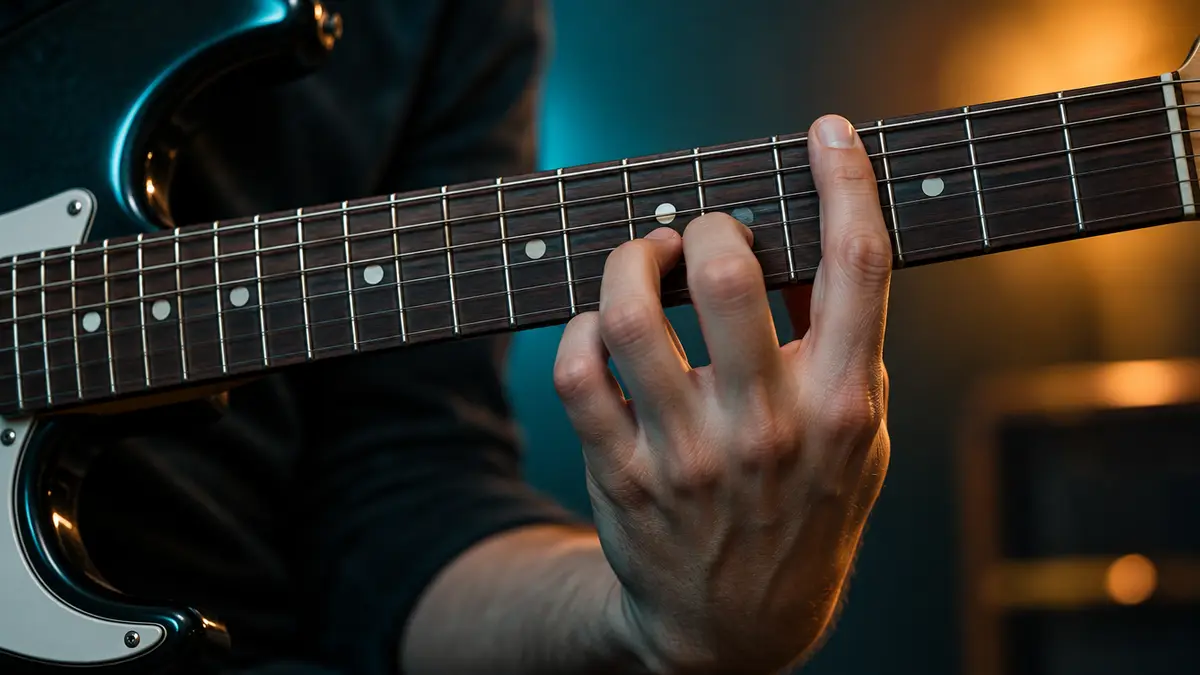
Legato uses hammer-ons and pull-offs so that most notes are sounded by the fretting hand, giving a smooth, fluid sound.
e|-5h7h8p7p5-----------5h7h8p7p5-----|
B|-----------8p6p5-----------8p6p5---|
- Hammer on firmly from above, as close to the fret as possible.
- Pull off slightly downward (towards the floor) to "pluck" the string with your finger.
- Mute unused strings with the picking hand palm and fretting-hand fingers.
Tapping
Use a picking-hand finger to hammer on and pull off notes high on the fretboard. A classic triad pattern on one string (tap = t):
e|-12t-5-8-12t-5-8-12t-5-8-12t-5-8-|
Tap with your middle finger so you can keep holding the pick. Pull off slightly sideways to sound the fretted note.
Sweep picking
Sweep picking plays arpeggios with one continuous pick motion across strings — like a slow, controlled strum where only one note sounds at a time. Start with three-string shapes:
e|--------12p8-------|
B|------10-------10--|
G|---9-----------9---|
   D  D   D   U  U     (A minor triad: A C E)
- Practise very slowly — sweeping fast but messy sounds bad.
- Lift each fretting finger as soon as its note has sounded, so notes do not ring together.
- Use a metronome and add 4 BPM only when it is completely clean.
Hybrid picking
Hold the pick normally but also pluck with your middle and ring fingers. Essential for country, and great for playing wide intervals and "chicken pickin'".
Arranging for solo guitar
- Find the melody of the song on the top strings.
- Harmonise key melody notes with a chord shape underneath (chord melody).
- Add a bass note on beat 1 of each chord change.
- Simplify — you do not need every note of the melody or every chord.
- Consider an alternate tuning like DADGAD or drop D for more open strings.
Ear training and transcription
The fastest-improving advanced players learn music by ear. Start with short melodies and solos you know well, and slow them down using software. Learn intervals by ear, and practise identifying the chords in a progression by their bass notes and quality (major/minor).
Practice structure for advanced players
| Block | Time | Example |
|---|---|---|
| Technique | 15 min | Legato runs at a set tempo, +4 BPM each week |
| Fretboard / theory | 10 min | CAGED arpeggios in a new key |
| Repertoire | 20 min | Learning or polishing a piece |
| Creativity | 15 min | Improvising over a backing track, writing a riff |
Frequently asked questions
How do I get faster at guitar?
Practise slowly with a metronome and perfect accuracy, then raise the tempo in small steps. Relaxation and economy of motion matter more than strength.
Do I need to learn modes?
Modes help you understand why certain notes sound good over certain chords. Dorian and Mixolydian are the most useful to learn first.