Fingerpicking Patterns for Beginners: From Simple Arpeggios to Travis Picking
Fingerpicking turns simple chords into beautiful, flowing accompaniment. Master the finger assignments first, then these patterns will fall into place.
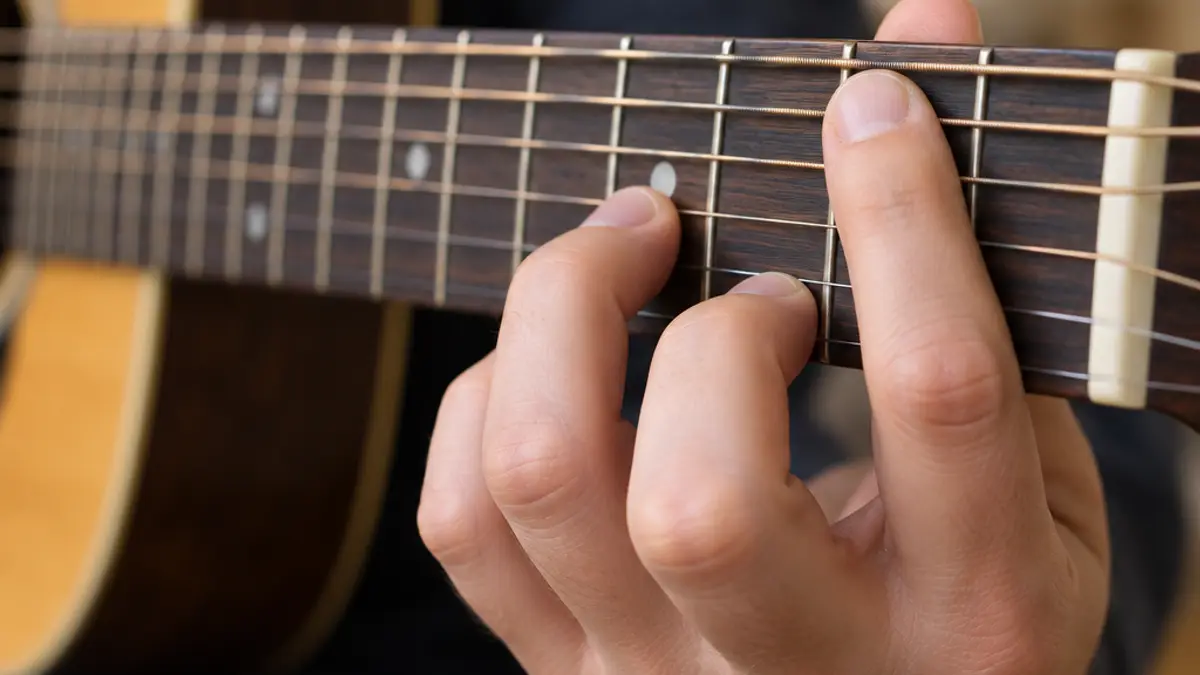
Finger names: p, i, m, a
Fingerstyle uses the classical Spanish names for the picking-hand fingers:
| Letter | Finger | Usually plays |
|---|---|---|
| p (pulgar) | Thumb | Bass strings 6, 5, 4 |
| i (índice) | Index | String 3 (G) |
| m (medio) | Middle | String 2 (B) |
| a (anular) | Ring | String 1 (high E) |
Rest your hand so the thumb is slightly ahead of the fingers, pointing towards the neck. Pluck with the fingertips moving towards your palm and the thumb moving down and slightly forward — the two should not collide.
Pattern 1: Simple arpeggio (p-i-m-a)
    C                   G
e|-------0-------|-------3-------|
B|-----1---------|-----0---------|
G|---0-----------|---0-----------|
D|---------------|---------------|
A|-3-------------|---------------|
E|---------------|-3-------------|
   p i m a         p i m a
The thumb always plays the chord's root: 5th string for C and A chords, 6th string for G and E chords, 4th string for D.
Pattern 2: Up and back (p-i-m-a-m-i)
    Am
e|-------0-------|
B|-----1---1-----|
G|---2-------2---|
D|---------------|
A|-0-------------|
E|---------------|
   p i m a m i
A flowing six-note pattern that fits perfectly in 3/4 or 6/8 time — great for ballads.
Pattern 3: Pinch
    C
e|-0-------0-------|
B|---1---1---1---1-|
G|-----0-------0---|
D|-----------------|
A|-3-------3-------|
E|-----------------|
   p+a i m i p+a i m i
A "pinch" means the thumb and a finger pluck at the same time. It gives the pattern a clear melodic top note on the beat.
Pattern 4: Travis picking
Named after country guitarist Merle Travis. The thumb alternates between two bass strings steadily on every beat, while the fingers add notes in between. It sounds like two guitarists at once.
- First, only the thumb: on C, alternate 5th string (3rd fret) and 4th string (2nd fret), then 6th-string (3rd fret, move finger 3) and 4th string. Count 1-2-3-4 and keep it steady.
- Add the index finger on the 3rd string on the "and" of beat 1.
- Add the middle finger on the 2nd string on the "and" of beat 2 — and so on.
    C
e|-----------------|
B|---1-------1-----|
G|-------0-------0-|
D|---2---2---2---2-|  <- thumb notes on 2 and 4
A|-3-------3-------|  <- thumb notes on 1 and 3
E|-----------------|
   1 & 2 & 3 & 4 &
The thumb must become automatic. Practise the thumb pattern alone while watching TV until you do not have to think about it — then add fingers.
Pattern 5: Folk alternating bass with strum
Thumb plays a bass note on beats 1 and 3; fingers brush down across the top strings on 2 and 4 (use the back of your nails). A simple bridge between strumming and fingerpicking.
Practice tips
- Start at 50–60 BPM with a metronome. Evenness is more important than speed.
- Keep the fingers close to the strings. Big movements slow you down.
- Let notes ring: keep the chord fully fretted until the change.
- Practise the picking pattern on open strings first, then on a single chord, then with changes.
- Nails: many fingerstyle players grow slightly longer nails on the picking hand for a brighter tone. Fingertips alone give a warmer sound.
Chords you will need:
Frequently asked questions
Is fingerpicking harder than strumming?
It requires more coordination at first, but many players find simple arpeggios easier than strumming patterns. Try both early on.
Do I need long nails to fingerpick?
No. Fingertips work well and give a warm tone. Nails give a brighter, louder sound, especially on classical guitar.