How to Write Your First Song on Guitar
You don't need years of experience to write a song. If you know four chords and one strumming pattern, you already have everything you need. Here's a simple, step-by-step method.
Step 1: Choose a chord progression
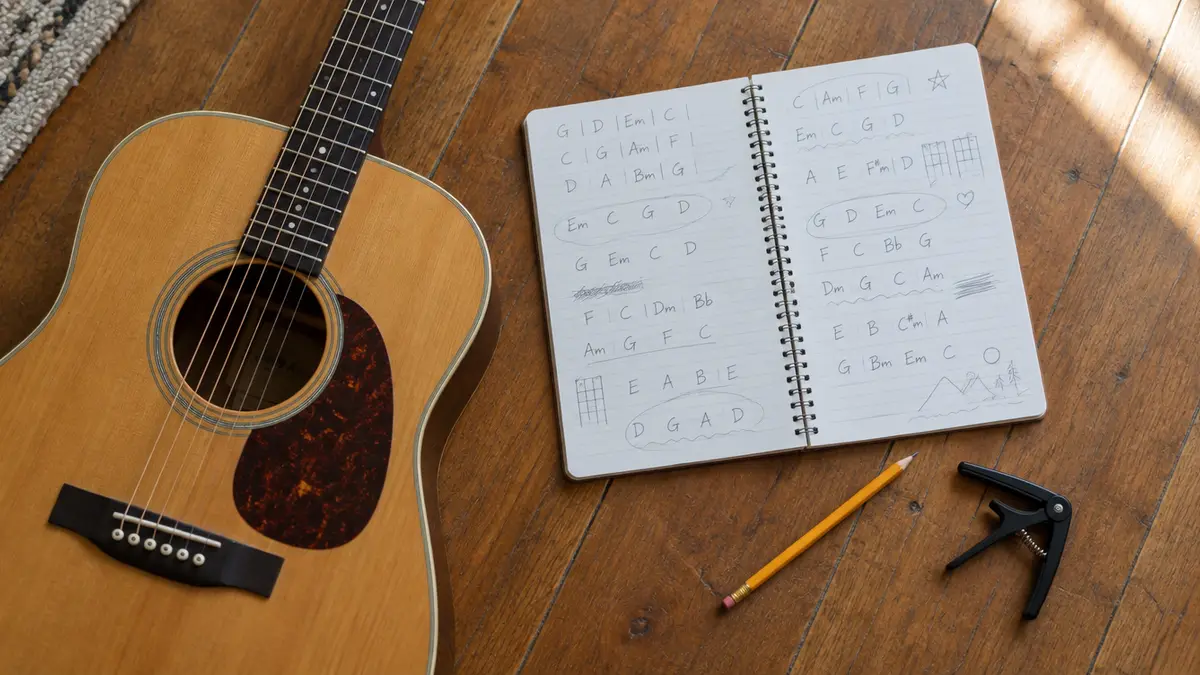
Chord progressions are not copyrighted — the same four chords power thousands of songs. Choose one of these to start, all in easy keys:
| Feel | Progression | In G (easy open chords) |
|---|---|---|
| Uplifting pop | I – V – vi – IV | G – D – Em – C |
| Emotional, reflective | vi – IV – I – V | Em – C – G – D |
| Classic, folk | I – IV – V – I | G – C – D – G |
| Dreamy | I – iii – IV – IV | G – Bm – C – C (Bm7 is an easy substitute) |
| Minor and moody | i – VI – III – VII | Em – C – G – D |
Want a different key for your voice? Use a capo, or our transposer.
Step 2: Use different progressions for verse and chorus
Contrast is what makes a chorus feel like a chorus. Easy ways to create it:
- Start the verse on a minor chord (Em) and the chorus on the major I chord (G).
- Change chords every two bars in the verse, every bar in the chorus.
- Strum softly and sparsely in the verse; play full strums in the chorus. See strumming patterns.
- Raise the melody in the chorus — choruses usually sit higher than verses.
Step 3: Pick a simple structure
The most common structure in popular music is:
Intro → Verse 1 → Chorus → Verse 2 → Chorus → Bridge → Chorus → Outro
For your first song, it is perfectly fine to skip the bridge: Verse – Chorus – Verse – Chorus – Chorus.
Step 4: Find a melody
- Loop your chorus progression and hum along without words. Record it on your phone.
- Hum for five minutes without judging. Then listen back and pick the best two-second idea.
- Build on it: repeat it, then change the ending the second time.
- Aim for melody notes that belong to the current chord, especially on the first beat of each bar.
- Keep it singable — small steps, a few leaps, and a range that fits your voice.
Step 5: Write the lyrics
- Start with the title. A short phrase that sums up the song, and usually appears in the chorus. Example ideas: "Back Before Dark", "Paper Boats", "One More Mile".
- The chorus says the big idea; the verses tell the story with concrete details — places, objects, moments.
- Show, don't tell. Instead of "I miss you", describe the coffee cup still on the shelf.
- Rhyme lightly. Near-rhymes (time / line, home / alone) sound natural and give you far more options.
- Match syllables to the melody — sing the lines as you write them.
Step 6: Add a guitar hook
A short instrumental phrase between sections makes a song memorable. Try a simple riff on the top strings over your first chord, or a single-note line from the pentatonic scale. Here is an original example over G – D – Em – C:
    G           D           Em          C
e|-3---3-2-0-|-2---2-0----|-0---0-2-3-|-0-----------|
B|-----------|------------|-----------|---1---0-----|
G|-----------|------------|-----------|-------------|
Step 7: Finish it — then write another
The biggest songwriting skill is finishing. Your first songs don't need to be great; they need to be complete. Set a deadline, record a rough version on your phone, and start the next one. Many songwriters say their tenth song is where things start to click.
Songwriting checklist
- A title that appears in the chorus
- Contrasting verse and chorus (chords, rhythm or melody)
- A melody you can hum after one listen
- Verses with concrete images
- A rough recording so you don't forget it
Frequently asked questions
Can I use the same chords as a famous song?
Yes. Chord progressions are not protected by copyright. What makes a song original is its melody and lyrics.
Do I need to know music theory to write songs?
No, but knowing which chords belong together in a key (see our theory guide) makes it much easier to find progressions that work.
How long should a song be?
Most popular songs are 2.5–4 minutes. For a first song, two verses and two or three choruses are plenty.