How Not to Quit Guitar: 12 Ways to Stay Motivated
Many beginners give up in the first few months — usually not because they lack talent, but because of sore fingers, slow progress and practice that feels like a chore. Here is how to be one of the people who keep going.

Why people quit
- Pain and frustration in the first weeks (sore fingers, the F chord).
- No clear path — random YouTube videos with no structure.
- Unrealistic expectations — comparing yourself to people who have played for 10 years.
- Boring practice — exercises without music.
- No time — practice never becomes a habit.
12 ways to keep going
- Make it tiny. Commit to just 10 minutes a day. On good days you will play longer; on bad days, 10 minutes still counts.
- Leave the guitar out. A guitar on a stand gets played; a guitar in a case under the bed does not.
- Attach practice to an existing habit — after your morning coffee, or before dinner.
- Play songs you love from week one. Simplify them if needed. See easy songs.
- Follow a plan. The 30-Day Guitar Plan removes the "what should I practise?" question.
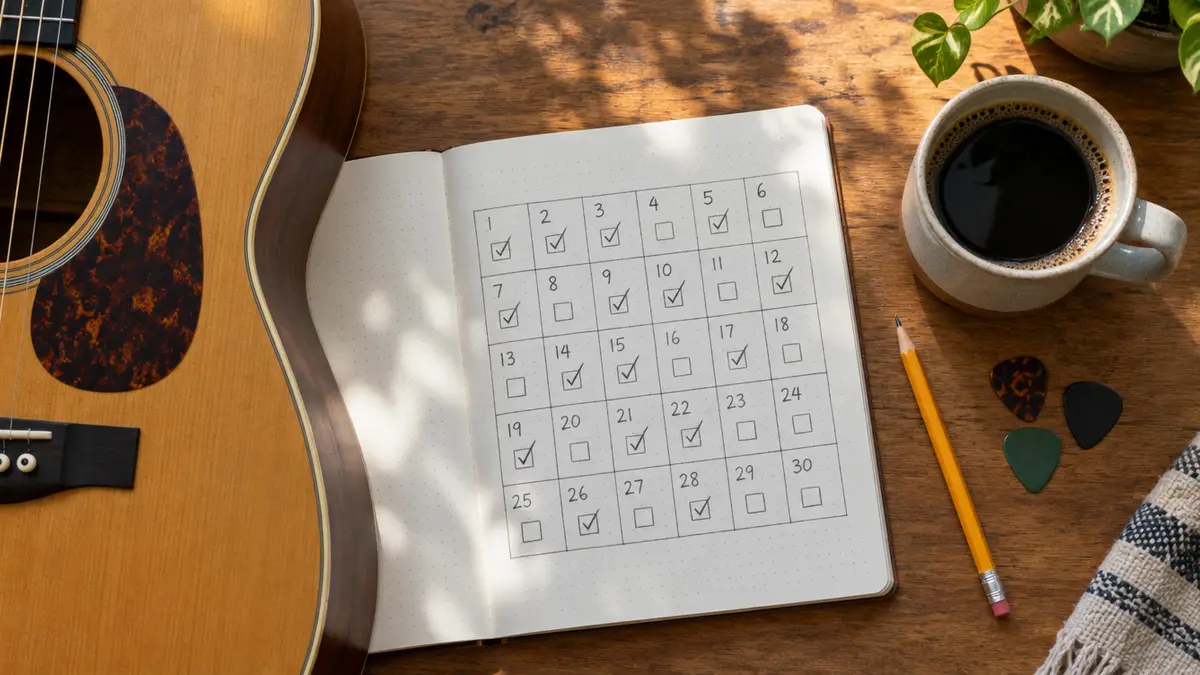
- Track your progress. Write down one-minute chord change scores and log your minutes in the practice tracker. Seeing numbers climb is motivating.
- Record yourself monthly. Listening back to last month's recording is the best proof you are improving.
- Set a small public goal — play one song for a friend at the end of the month.
- Play with others. Jam with a friend, join a class or a community group.
- Accept plateaus. Progress is not linear. Plateaus often come just before a breakthrough.
- Get your guitar set up. A hard-to-play guitar makes everything harder. See setup.
- Take lessons if you are stuck. Even a few sessions with a teacher can fix problems that stall you for months.
What progress really looks like
| Time (daily practice) | Typical milestone |
|---|---|
| Week 1–2 | Basic open chords, sore fingers, slow changes |
| Month 1 | Changes in time at slow tempos, first simple songs |
| Month 2–3 | Several songs, comfortable strumming patterns, calluses |
| Month 4–6 | Barre chords starting to work, pentatonic scale, basic fingerpicking |
| Month 6–12 | Playing most simple songs by ear or from charts, first solos |
| Year 2+ | Improvising, advanced techniques, writing your own music |
Everyone is different — these are rough guides, not deadlines. See learner milestones for more.
On bad days
Pick up the guitar and play one song you already know, just for fun. No exercises, no metronome. The goal is to keep the habit alive — and remember why you started.
Frequently asked questions
Is it normal to want to quit guitar?
Yes. Almost every guitarist has felt like giving up, especially in the first three months. Structure, realistic expectations and playing songs you love make a big difference.
How long until guitar gets easier?
For most people, the first big change is around 4–8 weeks, when calluses form and open chord changes become smoother.