Guitar Care, Setup & Maintenance
Guitar Cleaning, Humidity and Storage: Keep Your Guitar Healthy
Wood is a natural material that reacts to its environment. A few simple habits prevent cracks, sharp fret ends and costly repairs.
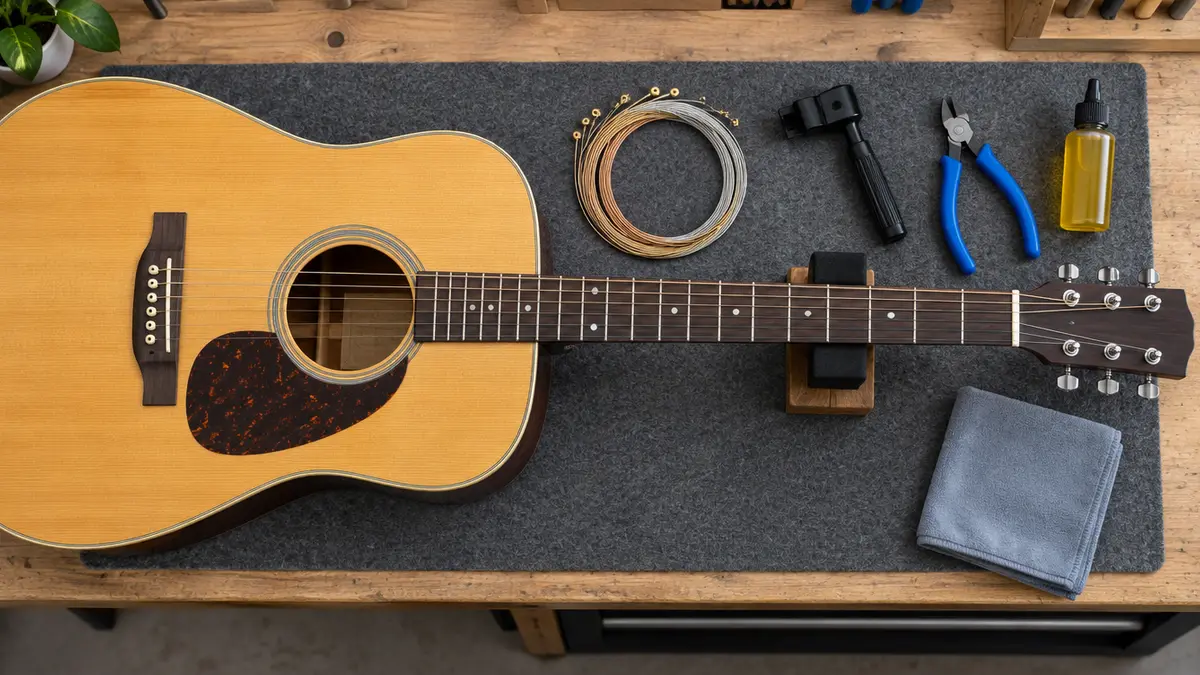
Everyday cleaning
- Wash your hands before playing.
- After playing, wipe the strings with a dry microfibre cloth — including underneath — and wipe the body and back of the neck.
- For gloss finishes, a dedicated guitar polish is fine occasionally. Avoid household furniture polish, which can contain silicone.
- For satin/matte finishes, use only a dry or very slightly damp cloth; polish can make them shiny and patchy.
- Some older nitrocellulose finishes can react with certain rubber or vinyl stands and straps — use nitro-safe stands for vintage-style guitars.
Cleaning the fretboard
- Clean when changing strings, every few months.
- Wipe with a dry cloth. For grime, use a slightly damp cloth or very fine (0000) steel wool on unfinished boards only — cover the pickups on an electric first, as steel wool fibres stick to magnets.
- On unfinished rosewood and ebony boards, apply a small amount of fretboard conditioner (lemon oil-based products are common) once or twice a year. Wipe off the excess.
- Do not oil a maple fretboard with a finished (glossy) surface — just wipe it clean.
Humidity: the most important thing
Guitars are happiest at about 45–55% relative humidity and normal room temperature. Solid-wood acoustic and classical guitars are the most sensitive.
| Too dry (below ~40%) | Too humid (above ~65%) |
|---|---|
| Sharp fret ends sticking out of the fretboard edge | Action rises; the top bulges behind the bridge |
| Top sinks around the bridge; action drops, buzzing | Dull, muffled sound |
| Cracks in the top or back (worst case) | Glue joints can weaken; bridge may lift |
| Guitar goes sharp / out of tune | Guitar goes flat; strings rust faster |
- Buy an inexpensive hygrometer to measure humidity in your room or case.
- In dry winters with heating, use a room humidifier or a case/sound-hole humidifier, or two-way humidity packs in the case.
- In humid climates, use a dehumidifier or air conditioning, and keep the guitar in its case with two-way humidity packs.
Storage
- Keep guitars away from radiators, fireplaces, air-conditioning vents, outside walls and sunny windows.
- Wall hangers and stands are fine in a stable room; a case is best in rooms with changing conditions.
- For long-term storage, loosen strings slightly (about a tone) but not completely, and store in a case in a climate-controlled room.
- Never store a guitar in a garage, attic, basement or car.
Travelling with a guitar
- Use a hard case or a very well-padded gig bag.
- Never leave a guitar in a hot car — heat can soften glue and damage finishes within an hour.
- After coming in from the cold, leave the guitar in its closed case for 30 minutes or more so it warms up slowly — rapid temperature changes can crack the finish.
- On flights, check your airline's instrument policy. Loosening strings slightly for cargo holds is common practice.
Frequently asked questions
What humidity should I keep my guitar at?
About 45–55% relative humidity. Use a hygrometer to check, and a humidifier or two-way humidity packs to adjust.
Can I clean my guitar with water?
Only a very slightly damp cloth, dried immediately afterwards. Never soak or spray a guitar.